The Ivy Lee method: plan your day with purpose
Published on
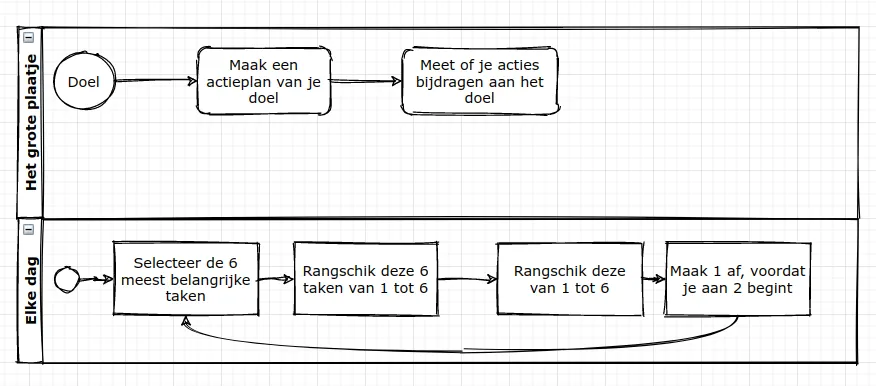
There are many complicated task and time management systems, but simple is always best. That is why the Ivy Lee method was developed. At its heart, it is a prioritized list of six tasks you want to accomplish in a day. You start with number one and may only begin task two once task one is completely finished.
This simple technique leads to intense focus and a results-oriented way of working.
It sounds very simple, but there are a few considerations. How does it work when you have several projects, for example? Read on to find out.
What is the Ivy Lee method?
The complete Ivy Lee method can be described in six steps:
- At the end of the working day, write down six tasks you want to get done.
- Put them in order of what really matters most.
- Work only on the first task until it is finished, then move on to the next.
- Follow the rest of the list in the same way.
- At the end of the day, repeat the process. Tasks that still matter move to the next day. Again, prioritize everything according to what matters most.
- Work through the rest of the list in the same way. Anything unfinished at the end of the day is reassessed and added to the next day if it is still relevant.
If this appeals to you, I also have a printable Ivy Lee method planner. Or read on for more background and tips on using it.
Why is it so effective?
The effectiveness of the Ivy Lee method is well established. In 1918, Mr. Lee was asked to make a steel magnate’s staff more productive. He did this by explaining the method above to the managers. It took him just 15 minutes per person.
His fee? Nothing, but if it proved effective, they could pay whatever they thought it was worth. That was how much confidence he had in his method.
Mr. Lee eventually received $25,000, the equivalent of $400,000 today.
The multitasking myth
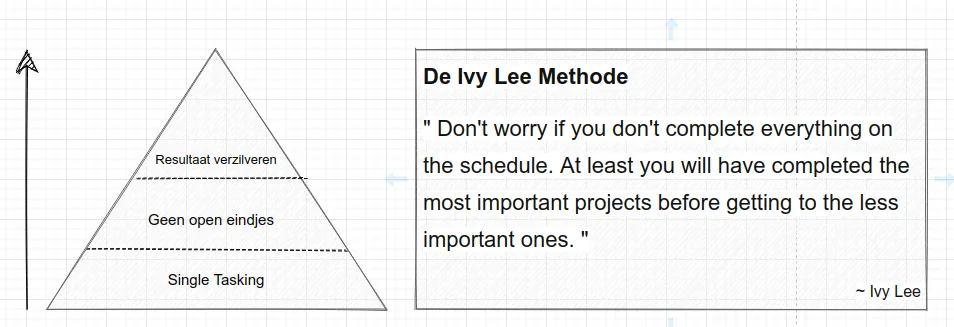
Multitasking was once hailed as the holy grail. It works for some people, but it has quite a few disadvantages. The biggest is that it makes it hard to stay focused and actually finish things.
Just like a renovation, you make progress on individual jobs, but your whole house remains under scaffolding. You do not actually deliver anything. Yet delivering something is what matters most. You can then benefit from the value you have created. Asking for feedback becomes easier too.
Finishing things also motivates you, making it easier to keep going.
Your goal is clear in advance
Another reason the Ivy Lee method is so effective is that you have a clear goal in advance. When you start your working day, you immediately know your first task and the smallest step needed to begin.
No loose ends
Having too many things open at once causes a huge amount of stress. Using the Ivy Lee method prevents this: you can only start the next thing once the previous one is finished.
This works even when you are responsible for bigger tasks. Simply split them up, list the parts separately and rank them. The smaller tasks become easy to finish, and you are not left with a huge number of unfinished things.
This frees up mental space to take on the next task with 100% focus. It is a powerful way to finish tasks, change course in time and spot unnecessary work early.
How to prioritize your to-do or action list
Ranking what you will do is an art in itself. Should you do something at all? A very good question, because many tasks on your to-do list are neither urgent nor important.
Ideally, you only take actions that directly contribute to your goal, which is often longer term. You do still need to keep fires in mind: things that are both urgent and important.
Some actions also produce new insights that may make the rest unnecessary. Identify those and start with them.
What really matters most?
It can be hard to work out what truly matters. Some tasks seem urgent or important, but are they really?
Above all, a task should contribute to an end goal. You should be able to achieve that goal within one or two weeks.
That end goal can certainly contribute to a larger overarching goal. Keeping the intermediate steps small helps you make sure you are progressing.
Stop when it is good enough
Many people, including me, tend to optimize things. But things really do not need to be perfect before you let others read them or expose them to the market. What matters most is getting out of your own bubble and testing what you have done as soon as possible.
It is much better to show others something that may not be quite perfect yet. You will know whether you are on the right track before investing more time. Perhaps it would be better to start again or do something completely different.
It is nicer to find this out as soon as possible.
Change course in time
Being productive and efficient also means daring to change course in time, even if you have already invested a lot of time.
When the goal changes, your task list should reflect that. The time and effort you have already spent do not change this. Better to turn back halfway than get completely lost.
The Ivy Lee method leaves plenty of room for this. It even encourages adjustment!
Having to prioritize your tasks again every day helps you change course in time. The most you can stray is one day.
Can a task actually be completed in a day?
A common stumbling block is putting an oversized task on your list. If something cannot be finished in one day, it is simply too big. You can often break it into smaller steps.
You can then tackle and complete, or skip, those small steps.
Completing more small steps and acknowledging your successes builds confidence. You keep following through on the commitments you make to yourself. This proves that even the biggest goals can be broken into smaller subgoals. Achieve those small subgoals, and you will eventually achieve the big end goals too.
You build trust in the process!
Use it to reflect
The Ivy Lee method is also very useful for reflection. Does what you do contribute to the results you expect?
To do this, however, you need measurable goals. You can then see whether the steps toward that measurable goal were too difficult, or whether something else prevented the desired result.
Each day gives you an indication of whether your goal is too big or you simply have not allocated enough time. With a short period of one day, you immediately see why something is not working and you are not progressing. Or why it is, of course.
Nuances and tips
The best approach is simply to start using the Ivy Lee method yourself. You will naturally encounter a few challenges.
I have listed the most common ones for you, so bookmark this post to return to later.
Weekly goals
With the Ivy Lee method, it is important to have a clear big picture. Weekly goals can play a major part in this.
Setting a weekly goal helps you ensure that daily actions contribute to the final result. You can keep testing whether your to-do list actually produces results or merely keeps you busy. Adjusting when needed becomes much easier too.
Break up large tasks
The problem with large tasks or goals is that it is hard to work out where to start. They are often so far away that it is difficult to see your progress. Not very motivating.
Try breaking a large task into smaller ones. You can go a step further by breaking those into starting steps. Starting steps remove the resistance to beginning.
For example, you could break writing your final thesis into:
- Make an outline.
- Break the outline into headings and paragraphs.
Your starting steps could then be:
- Open Microsoft Word.
- Write a sentence.
Another example: I recently needed new ink. The starting step could be finding out which printer model you have. The next steps then follow automatically, because you have already started.
You are effectively tricking your brain by starting easily, and momentum eventually takes over.
Ask whether it contributes to the goal
Working efficiently alone is not enough. You can run yourself ragged very efficiently. To get results, combine efficiency with purposeful tasks. Continually assessing whether something still contributes to your end goal helps you reach it as quickly as possible.
Sometimes it may be better to postpone certain things. If you are developing a new product, for example, you want to get it to customers as quickly as possible. A beautiful design is nice, but if the product does not do what it promises, looking good does not matter!
One way to approach this is to tackle the riskiest part first. Are there assumptions that matter to your decisions? Test those assumptions as soon as possible.
You can apply this to studying too. Working backwards, starting with what you need to know for the exam, lets you work effectively. You can then find the right materials for the skills you want to develop. You might choose to skip official course material or find other information online that explains the subject more clearly.
Several projects
Having only one project at a time is the exception. You probably have projects at work, personal projects, household tasks and plenty of other lists.
How do you apply the Ivy Lee method when working on several projects?
Simple! First, give your projects or hobbies a few hours each week in your calendar. You can then apply the same method to each project.
Reserving time in your calendar ensures you make progress on individual projects every week. With a prioritized list, you immediately know what to do during those time blocks.
Be careful not to take on too many projects at once. Each project needs a critical amount of time to actually get finished.
If you notice you are not making enough progress on each project, allocate more time per week or end a project early.