Be selective about the information you consume
Published on
All kinds of information come at you throughout the day: the misery in the news, songs on the radio at work, and so on. I have noticed that the information I take in makes a huge difference to me, whether consciously or unconsciously.
Deliberately consuming less information can bring a sense of calm and purpose that you really should experience for yourself.
Read to the end to change course easily, step by step. Want to skip the why and go straight to the how? Go directly to the section “An alternative: conscious information consumption.”
The danger of too much information
If you are open to the idea that there can be too much information, it is worth looking at all the ways this can show up, and which apply to you. Bear in mind that too much entertainment can fall into this category too.
You train yourself to be distracted
In sport, you practice a particular movement and get better at it. This also applies to mind sports such as chess, where the “movement” is mental. The funny thing is that everything you repeat is a kind of training, including repetitions you do not actually want. It reinforces a particular pattern.
By letting yourself get distracted and choosing to scroll instead, you train a pattern too. Sometimes it gets so bad that you have a TV program on and still pick up your phone to browse Instagram. The pattern you are training is being distracted while doing things.
Often, this does not only start after you finish your workday or school day, but in the morning. Many people, and I am guilty of this too, fall asleep with their phones in the evening. All the news and entertainment are processed by your subconscious during sleep, reinforcing the pattern of being distracted.
To top it off, the first thing many people do in the morning is reach for that phone again. Which messages, updates and DMs have you missed?
You start your day reactively straight away. Instead of beginning with the things you consider important, you are busy with someone else’s agenda.
Conflicting interests of information sources
“If you don’t read the newspaper, you’re uninformed. If you read the newspaper, you’re mis-informed.”
Mark Twain
Something connected to this quote is that newsletters and social media have conflicting interests. You and I want to keep up with the news and what our friends are doing.
Perhaps even find and share some funny memes.
Social media companies and even news organizations aim to keep you on their platform as long as possible to generate advertising revenue. I do not want to get into whether everything posted is true, but let us assume for convenience that it is.
Even then, news and content are given an emotional charge to make you react to that content, instead of forming your own reaction and opinion.
It gets even worse.
Companies such as Instagram even have a duty to act honestly and responsibly in the financial interests of their shareholders. That means they have to design their products and services to keep you distracted from other things for as long as possible.
Should you stop following the news entirely, then? No, there are ways to stay up to date. Keep reading to see how to change course without missing anything.
Your brain thinks you are doing something useful
Your brain does not know the difference between reading about something and actually working on it.
-
The dopamine system fires for both activities.
-
The result is that an activity that gives a “real” reward…
-
The “real” things that give life meaning feel less good, because your brain is already used to a flood of dopamine from things such as Instagram.
Of course, learning is important. But you then need to use what you learn. Otherwise, it is not much use to you.
A good stopping point for asking yourself whether you are still learning effectively can be:
-
Lines of thought such as “what if this, what if that?”
-
Noticing that trying something could be easy and take less time.
It feels like relaxation, but it is not
“Yes, but I need to relax for a bit. Just enjoy some scrolling and do nothing. Spend a little time on Instagram looking at funny memes.”
The funny thing is that it does not really relax you. What you are doing is disconnecting yourself from reality, losing yourself in an endless newsfeed. That newsfeed is designed to keep you occupied.
That is what those apps and websites make money from: attention, use and eyes on advertisements.
Not only that, but the news also bombards you with misery. Not to minimize all the terrible things in the world, but you cannot change 90% of what you are bombarded with. All those images, impressions and words still linger in the background of your subconscious. This creates a low level of chronic tension.
“But it is not all doom and gloom. There are always nice things on Instagram. How can that make me feel bad?”
-
Selection at the gate. Almost everyone uses filters and selects the best things to share. This leads to a focus on results instead of process, and a distorted picture of how things really happen.
-
Fear of missing out. The idea that you have to join in too. This creates an overall negative feeling and effect on your peace of mind and productivity.
Where do you stand with information consumption?
The first step in an experiment to do something differently is awareness.
Where do you stand with your social media use? Do you read things such as the newspaper, or watch the NOS news? How do you feel before, during and after these activities? These are useful things to examine.
Once you are aware of the costs, but also what it gives you, you can choose what and how much of it to consume. The key word here is choice.
There is basically nothing wrong with a little daydreaming or enjoying Instagram now and then, if you need or want it. But it would be a shame if this were unconscious, driven by other underlying reasons.
At what moments?
When do you open Instagram or Twitter? Is it deliberate? During your break, or after work?
How long do you spend on social media?
The average Dutch person aged 20 to 39 spends two hours a day on social media platforms. How long do you spend?
Fortunately, it is easy to track. There are various tools for it. Android has a Digital Wellbeing tool that logs screen time per app, and a similar option is tucked away in the iPhone settings.
I use a piece of software called RescueTime. You can also install it on your Linux computer or Mac. The app even sorts your screen and website use into different categories. At the end of the week, you also get a usage report by email.
The first time might be a shock, but the tool does not lie.
Here is an example of such a report.
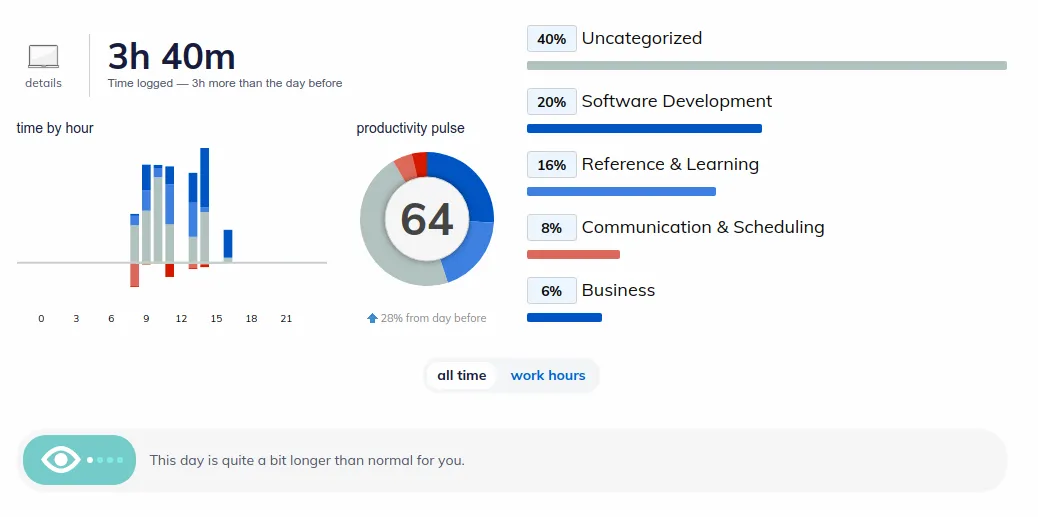
This is one from the installation on my work computer. You can see that email takes quite a lot of time. You can also drill into each category to see which specific sites take a lot of time.
A very powerful tool, in other words.
An alternative: conscious information consumption
The alternative is to decide consciously: I will consume this information in this way, and not that information. It does not matter what choice you make, as long as it is conscious.
What you want to avoid is unknowingly losing all your time to something you do not really want. Instagram Reels can be an example, and sometimes it is for me.
I can also tell you straight away how I solved this for myself. I removed Instagram from my phone. Do I want to find and share some reels and see what I have received? Then I use Instagram’s browser version on my phone. It is much less addictive because it works much “worse.”
Ideal if you want to reduce your Instagram time.
A social media diet
Here too, it is a good idea to ask yourself what you could gain. Although this differs from person to person, it has given me the following:
More intense experiences
All your experiences become more intense because you are consciously present without distraction. This can be something as simple as a walk in nature, good conversations or sitting outside a café with friends. When your phone is not distracting you, it is easier to have a richer, deeper experience.
More focus
It is easier to concentrate on one task at a time. By turning off all notifications, you take responsibility for where your attention goes. You train yourself to pay attention instead of training yourself to be distracted. A big difference!
Eventually, whatever you train becomes easier to do, regardless of whether you train it consciously or unconsciously.
Space
Space opens up to think about things. You become aware of what you do and do not want. Space in the form of time, and also in the form of a pause between thought and action.
This pause between thoughts and actions also helps you untangle your habits and think about what you really want. In other words, a self-reinforcing upward spiral.
You learn more easily
I read more and more about the subjects I am working on. That could be my triathlon training, horse riding or work. Making blogs and programming software.
Because the time I would normally spend on Instagram is freed up, I have enough time for this. And because I read books on my e-reader, I am not distracted by those websites and apps either.
Make deliberate information choices more accessible
The idea is to make the choices you want to make as easy as possible, and the ones you do not want to make harder.
You can do this in all sorts of ways, from the devices you use to separate inboxes and social media accounts.
Use devices without distractions
Some devices are particularly suited to just one task. An e-reader or an e-ink tablet such as the reMarkable is an example. You cannot do much more with it than read books and take notes.
Ideal if that is all you want to do at that moment!
Curate your feeds
You can extend the same principle. Almost every tool has a way of grouping particular types of content. For tools that do not, you can simply create a new account with a different email address.
For Instagram and YouTube, for example, I have an account where I subscribe to absolutely everything, and another where I only subscribe to “useful” content. For me, that mainly means videos about building software and all the sports I do.
Temporarily block the addictive elements
Another option is to disable the addictive elements: the newsfeed and related videos.
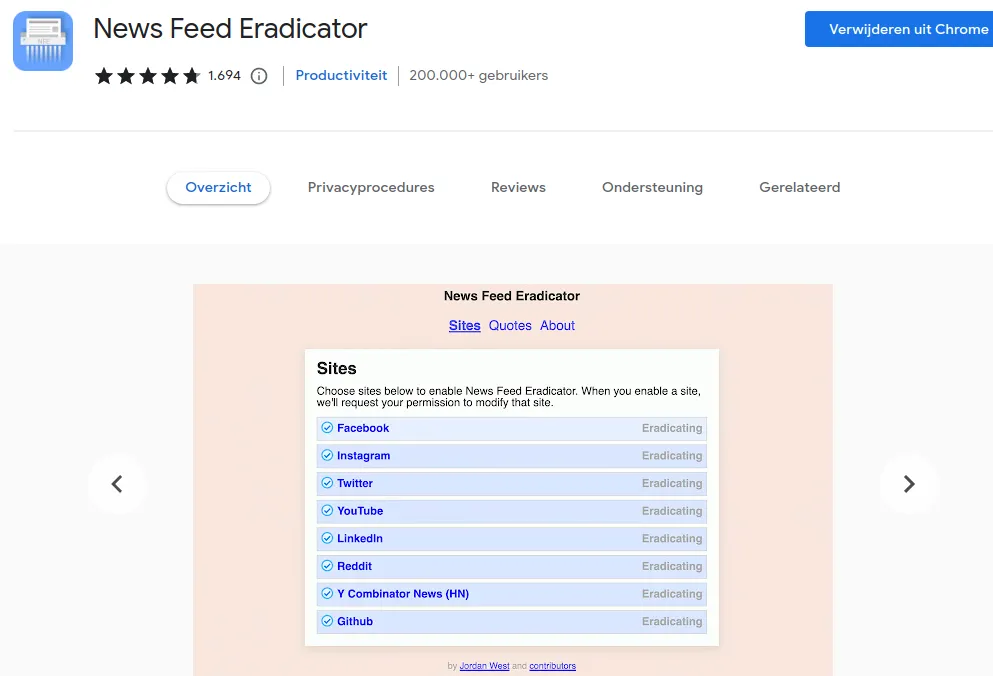
A good plugin for this is “Newsfeed Eradicator,” available for both Chrome and Firefox.
How to start today
“All difficult things have their origin in that which is easy, and great things in that which is small.”
~ Lao Tzu
Would you like to start consuming information selectively too? Choose one thing from this blog and try it for a week. Whether that means replacing your phone with an e-reader or creating separate YouTube and Instagram accounts where you only follow people whose content you can use directly.