Regular self-reflection: a practical approach
Published on
Self-reflection sounds vague, but it’s actually very simple. You can make it as big or as small as you like. At its heart, you pause to consider what you’ve done, whether it’s what you want, and how you might want to do things differently in the future.
Self-reflection helps you avoid falling into the same trap again and again.
Why self-reflection is worth your time
It may seem like yet another thing you “have to” do. Fortunately, you don’t have to do anything, and you can add it to your life in less than a minute.
The cost is very low, while the benefits are substantial.
Uncovering patterns
Suppose you write down what went well and what went wrong each day, and why. When you write roughly the same thing four or five times in a week, it becomes clear that you’re repeating certain patterns. That can give you valuable insight into what to change.
When you keep things in your head, it’s often harder to notice a pattern. The idea is that self-reflection and writing things down help you live more consciously.
Doing everything more consciously
I’m a firm believer in the principle that how you do one thing is how you eventually do everything.
Taking a small moment each day to be aware of yourself and your actions makes you more conscious in the rest of your life too.
A small investment of time improves the quality of every activity you undertake later in the day.
Clearing your head
Anything that stays on your mind can cause stress. The little voice that goes over everything and has an opinion about it isn’t always easy to direct.
This happens more often with things left “open”: something you still have to do, or something you have strong feelings about. It stays active in the background.
This is also known as the Zeigarnik effect.
Getting it out of your head and onto paper doesn’t just clarify the idea in your mind; it also creates space. It often starts to feel like a little closure, or at least like you’re making progress.
Why a method for self-reflection is a good idea
You don’t need a method to reflect, of course, but it helps.
It gives you structure and a rhythm that keeps you evaluating. Especially when everything is going well, you may be tempted to let it slide. That’s precisely the danger: when things work, you need to keep doing what works rather than ease off.
You may also find it helpful to evaluate digitally or on paper by writing down your insights.
The “what went well” method
This isn’t the method’s official name, but it describes it well. It’s the format I use.
The format is simple and consists of three questions:
What three things went well?
-
_
-
_
-
_
What is one thing that could be better?
- _
What can I do to achieve that?
- _
This method emphasizes what went well, which is why there’s space for three things. It’s best to limit improvements to one.
Self-reflection isn’t about tearing yourself down. Focusing only on areas for improvement can affect your well-being. The aim is to develop a realistic picture of yourself.
Gratitude reflection
The gratitude method is very simple. Write down three things you’re sincerely grateful for. They can be as big or as small as you like. You can write full sentences or just keywords, as long as you really pause to consider them.
It could be your health, your job, your home, or even being able to experience the cold of winter.
It’s very personal.
You don’t actually have to write it in a notebook or your digital notes, though it helps. This method takes very little time, but the challenge is avoiding simply going through the motions. Its power lies in pausing and really experiencing it in your mind and body.
When it becomes a chore, the effect is much weaker. Try to convince yourself of its value by looking back occasionally too. If all goes well, you’ll see new challenges appearing in your reflections.
It changes your attitude and mindset
You may be wondering why this works. The principle is very simple. You can’t be angry and happy at the same time. You can’t be stressed and relaxed at the same time. You can’t feel gratitude and any arbitrary negative emotion at the same time.
The best time to reflect
Two moments are particularly good for this exercise: your very first thought in the morning and your very last thought before sleep.
In the morning, it ensures you start everything with the right attitude. In the evening, it helps you get a good night’s rest and quality sleep.
Free-form self-reflection
On a blank page, you can write anything you like. Free-form reflection is a very useful tool for organizing your thoughts and uncovering your responses to them.
It can also be intimidating, precisely because you’re starting with an empty page.
To give yourself some direction, you can make notes on these subjects:
-
Inspiration
-
Insights
-
What patterns do you recognize?
-
What did you find difficult?
What inspires you?
There’s beauty and inspiration in everything around you. How wonderful to capture it when you notice it.
Just today, I went outside to put the bin out and was struck by a clear night full of twinkling stars. How beautiful is that!
What insight did you have today?
“Don’t watch the clock; do what it does. Keep going.”
Sam Levenson
What insights have you gained? They can be as big or as small as you like.
Here’s an example of an insight from my own Obsidian vault.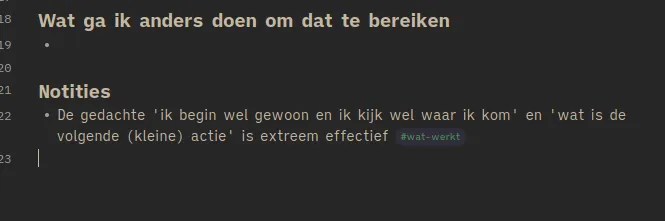
What patterns work?
Sometimes you’re working on something, or doing something slightly differently, and suddenly realize: “Hey, this works pretty well.”
That’s the moment to write it down. You’re helping yourself by consciously recording it and pausing to think about it, and you can also share the insight with others later.
What did you find difficult?
Some things are always difficult: breaking patterns, doing things differently, and so on.
What makes something difficult? Simply writing it down gives you a starting point. From there, you may be able to draw out insights or better approaches later, or perhaps immediately.
Tips
This method works well digitally. Personally, I’ve created a notes field in my journal.
I leave space there for insights. I tag everything so I can go through it all at least once a month.
The one-sentence method
The previous methods ask quite a lot of you. That can be difficult, especially when you’re just starting.
The one-sentence method is an ideal stepping stone.
Your goal is simple: write one sentence every day.
It sounds too simple to have an effect, but appearances can be deceiving. Pausing consciously each day, even for just one sentence, changes your attitude.
You move from reactive to proactive.
This is a fundamental attitude. It transforms everything you’re doing. The quality of how you approach all your other tasks will gradually change.
What to reflect on
What can you apply this kind of self-reflection to? Almost anything! Your productivity at work as well as your performance in sports.
You can reflect on your state of mind, as simply as recording it with a smiley face.
Ultimately, “everything is kung fu.” How you do one thing is how you do everything. Perhaps not immediately, but that’s where it moves over time. You don’t need to reflect on everything to see change in everything you do. Things you were unaware of rise to the surface and come to light.
What to do with insights from self-reflection
Looking back at what goes well is a powerful tool for building confidence and continuing to do what works.
Explore an insight more deeply later
You don’t always need to act on an insight immediately. Sometimes it isn’t clear, and something has several facets. Something isn’t necessarily true in every situation. It may turn out to be slightly different.
Just write it down; you can always add to it later. If you uncover a symptom of something underlying, it’s worth exploring later. Once it’s on paper, you can’t forget it either.
The reflection process naturally gives rise to curiosity. That can eventually lead to new insights and actions.
Change course
Reflection allows you to adjust your course little by little.
You can do this effectively by trying something new based on the patterns you’ve recognized.
Try recording it as a Tiny Habit: a small habit. A Tiny Habit has a starting point (an anchor) and a small action anyone can do.
For example, to drink more water during the day, you could try this Tiny Habit:
“After I walk into the kitchen in the morning, I get a glass of water and take one sip.”
Accept insights
You can consciously choose to leave the situation and the insights you’ve recorded as they are. You can’t act on everything immediately, and sometimes simply becoming aware of something brings considerable relief.
You know it’s happening, and it’s out of your head.
Make keeping your self-reflection journal easy
As with anything new, it may feel a little unfamiliar at first. Sometimes it’s easy to forget too. Things that are easy to do are also easy not to do.
Fortunately, there are ways to make it a habit in your life.
Make it accessible
Keeping a journal or reflecting on yourself becomes easier as you reduce the number of steps involved. Out of sight, out of mind.
It can be as simple as a shortcut on your desktop to the file where you record everything.
If you prefer pen and paper, you can leave your notebook open on your desk with a pen beside it.
Don’t make too much of it
You don’t need life-changing, world-changing insights every day. Sometimes you have them and sometimes you don’t. That doesn’t mean you can’t pause to appreciate the small things in life. Ultimately, big things and valuable insights are also made up of small building blocks.