Prepare your week: how to make an action plan
Published on
“A fool with a plan can outsmart a genius with no plan any day.”
No idea who said this
A plan is an important tool for reaching your goals. It gives you some reassurance that you are moving in the right direction. It helps you see whether you are actually doing what you planned, and whether those planned actions contribute to the result you want.
A plan helps you:
-
Give your day structure.
-
Assess whether everything fits into your day.
-
Have a guide for investigating where things go wrong.
-
Stay motivated by building on small successes.
And those are precisely the things that matter most for reaching your goals: clarity and personal accountability. An explicit plan gives you all this and more.
You are always following a plan
It sounds intimidating, but you already follow a plan. The problem is that it is often someone else’s. Take lunch at school or work. If you do not bring your own, you depend on what the cafeteria offers. Often that is processed junk with lots of carbohydrates.
How great would it be to solve your after-lunch slump by planning and carrying out a few actions earlier in the day?
The point is that you either follow your own plan or someone else’s. Someone else’s plan may not be designed around what is best for you.
You will have to take responsibility for that yourself.
Break a big goal into small steps
A big goal can be very intimidating. Perhaps it is a pay rise or running a marathon. Without a plan to work toward it, it quickly feels out of reach. That is why starting small matters when you make a plan too.
You can always adjust or do more later once you get a taste for it.
How to make a simple plan
Perhaps “plan” makes you think of an endless document full of vague language. It need not be that way! An effective plan can be just a few sentences long.
You can make a plan as big or small as you like.
It can cover every aspect of your life or focus on particular activities, moments or goals.
What is your goal?
The first step is to clarify your goal. An easy example is a common goal: losing weight. You can make this explicit by aiming to lose a particular number of kilos, or buying clothes in a size you want to fit into. Whatever your goal, make it measurable and explicit.
Examples include:
-
Run a marathon in under three hours.
-
Lose six kilos.
-
Work on my tasks with focus.
These are measurable outcomes you can attach small actions to.
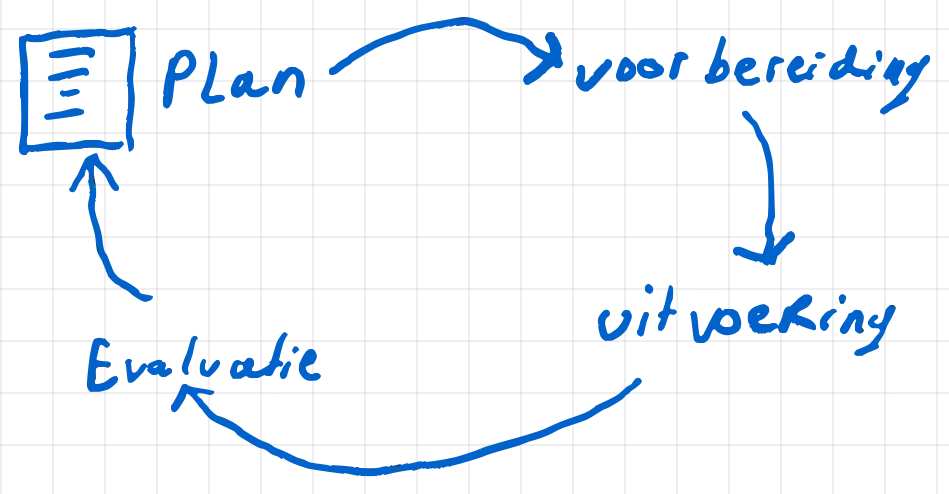
What actions do you need to take daily?
A goal alone is not enough. But once you know your goal, you can usually work out fairly quickly what is involved. Google, or asking questions on Reddit or Facebook, can get you a long way.
If you really do not know where to start, you can always hire a coach or expert. A really good coach also considers the “how” behind it all. They will regularly sit down with you to examine why things are or are not working.
Make your initial actions as small as possible. This helps ensure you actually do them and do not dread them. Proving to yourself that you can do it builds confidence.
Gradually, you become the person who has already achieved the goal.
Tips for continuing to use your plan
How do you keep using a plan? There are clever approaches, but it comes down to making it fun and easy. That matters most. You can have an enormous plan, but if it is hard to use or the tasks are difficult, you will not keep it up.
You can always expand the size and complexity of your plans when you are ready. Starting small really is the most important thing.
I like printing out my plan. I have a weekly overview listing the exercises I want to do each day. I started very simply with a few stretches, gradually expanding it to include more complicated strength exercises.
I keep this overview in my exercise room. My overall plan says that after getting up, I go straight to my home gym. That is already a small win, because showing up is the first step.
Another tip is to limit your plan to five or six actions at most. You can split them by part of the day or location if needed.
You can also keep carrying out a plan enjoyable by taking a playful approach. There is software for this, such as Habitica. It turns your life into a role-playing game. Checking off actions and doing tasks earns you gold and points, which you can spend on items for your character.
You can follow the same general principle without a game too. Life is too beautiful to take too seriously.
Evaluate the plan
Continuing with a plan without knowing whether it works is not very useful. Sometimes, when driving somewhere without knowing the way, you begin to doubt yourself. I usually stop and get my phone out. I open Google Maps to see where I am and whether I am still on the route. You should do the same with your plan.
Especially at first, when you are not quite sure where you are going, it is fine to check Google Maps, or your plan, more often.
Here are some questions you can ask to see whether you are still on course.
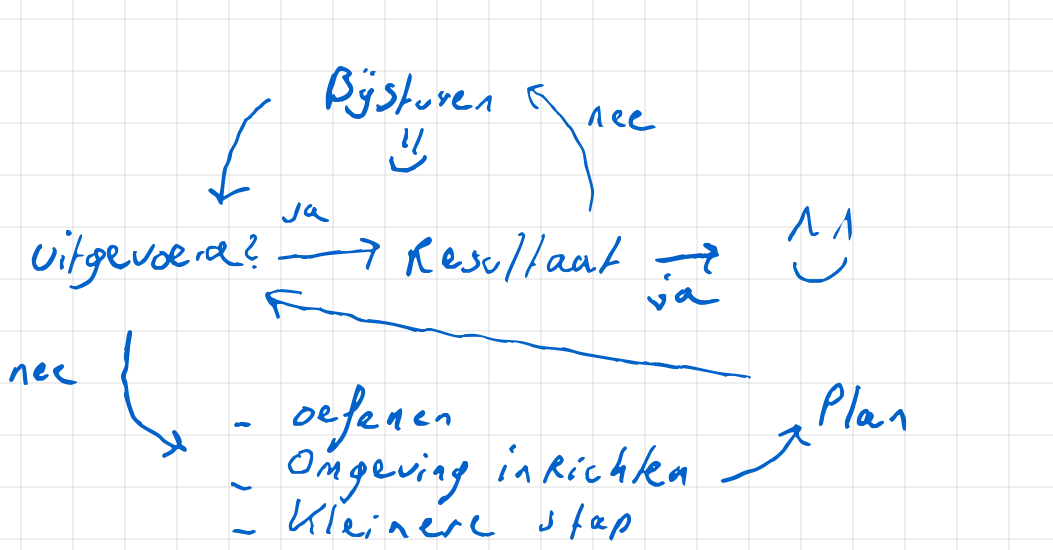
Am I doing what I need to do?
If not, ask why. Are there things you need to do before you can do what you intended? Do you forget to do something? Investigate and solve this step by step.
Think of untangling your earphones. You start by looking for the easiest knot. Every knot you undo makes the rest easier and easier.
Am I doing everything but getting no results?
If so, you may need to adjust your action list. Be careful not to adjust too early, though: give things a chance to work.
You can also ask a few preventive questions at the end of the week.
What can I do to make the step smaller?
If cooking every morning takes too much time, you could also… The reverse works for actions you do not want to take. You can make them harder by not giving them space in your home.
Make the feedback cycle as short as possible
As you get quicker at noticing whether you are on course, you may no longer need to review your plans every week. When things do not go as they should, you will notice naturally. This develops as you work consistently with your plan.
To see a difference as quickly as possible, shorten the path to the first visible result. This has several advantages:
-
It is easy to achieve.
-
It builds confidence because you do what you told yourself you would do.
-
It makes it easier to notice how your life changes through your choices and actions.
The action list can always change
Do not get fixated on your action list. If certain things do not work, you can always adjust.
You often discover that certain steps toward your goal are too big. Some tasks may also be blocked. Suppose you want to cook an egg every morning as part of losing weight. If your kitchen counter is full, that is difficult. It can help to add an action to wash at least the pots and pans in the evening.
You keep adjusting and changing little by little, without it feeling insurmountable. You gradually grow into the person you want to be.